
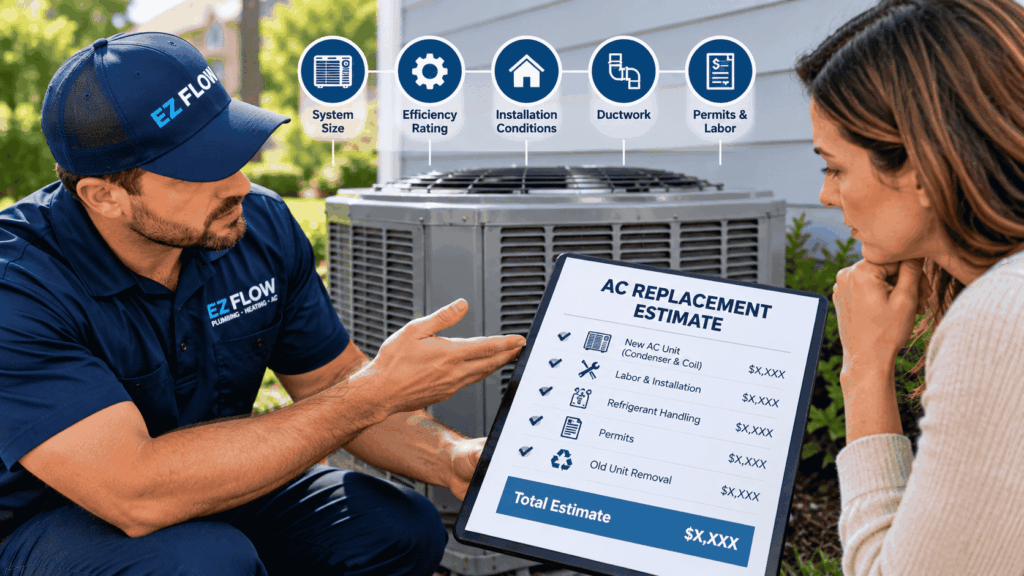
For a central air conditioner replacement, existing ductwork, matched outdoor condenser and indoor evaporator coil, labor, refrigerant handling, permits, and old-unit disposal, most homeowners in 2026 see installed quotes somewhere between $4,500 and $12,500, depending on capacity, efficiency, equipment, and installation conditions.
A standard 3-ton mid-efficiency system in moderate conditions typically falls in the $5,500 to $8,500 range. Those figures are planning references, not quotes. Your actual number depends on what is being replaced, how your home is configured, and what work the installation actually requires.
What Does an AC Replacement Price Actually Include?
| Replacement Scope | What’s Typically Included | Common Confusions |
|---|---|---|
| Central AC only (most common residential replacement) | Outdoor condensing unit + matched indoor evaporator coil, labor, refrigerant handling, electrical connections, condensate drain, startup/commissioning, old-unit removal and refrigerant recovery, permits | Some quotes include a new evaporator coil; others do not, this alone can represent $600–$1,500 of scope difference. Confirm before comparing. |
| AC + furnace or air handler (full HVAC replacement) | Everything above + gas furnace or air handler replacement, controls; more extensive system integration | Competitors routinely mix full HVAC replacement prices into “average AC replacement cost” tables. These are different projects at substantially different price points. |
| Online equipment-only price | The outdoor condensing unit (and sometimes the indoor coil), the physical hardware only | An online listing for a $2,200 condenser is not an installed price. Labor, refrigerant, permits, electrical, commissioning, removal, and contractor overhead are not included. The gap between an equipment listing and a contractor quote is not “markup”, it is real installation work. |
| First-time central AC installation | All of the above + new ductwork fabrication, new electrical circuit, new drainage, full materials | First-time installation cost is significantly higher than replacement cost. These should never be averaged together. |
AC Replacement Cost: The Factors That Actually Change the Price
The largest price differences usually come from the equipment being selected and the amount of installation work the home requires.
| Factor | Lower-Cost Scenario | Higher-Cost Scenario | What to Ask |
|---|---|---|---|
| System capacity | Smaller required system; confirmed by load calculation | Larger required system; confirmed by load calculation | Was a Manual J load calculation performed to verify sizing? |
| Equipment efficiency (SEER2) | Meets DOE minimum (14.3 SEER2 in the North) | High-efficiency (16+ SEER2) or premium system | What SEER2 is being quoted? Does it meet regional minimums? |
| Compressor technology | Single-stage compressor | Variable-capacity or inverter-driven compressor | What type of compressor does this unit have? |
| Indoor coil | Existing coil compatible with new equipment | New evaporator coil required | Is the evaporator coil included in this quote? |
| Ductwork | Existing ducts serviceable; no work needed | Repairs, sealing, or modifications confirmed necessary | Has ductwork been inspected? What’s the scope of any duct work in this quote? |
| Electrical | Existing disconnect and circuit suitable | Circuit or disconnect upgrade required | Is any electrical work included? What specifically? |
| Installation access | Ground-level, easy equipment access | Attic, rooftop, crawlspace, restricted access, equipment relocation | Are there any access or complexity factors affecting this project? |
| Permits | Standard mechanical permit in a straightforward municipality | Multiple permits; code-mandated upgrades | Are permits included? Who pulls them? |
Brand can affect equipment price too, but a useful comparison has to control for capacity, efficiency, compressor technology, controls, warranty and model tier. Comparing an entry-level unit from one manufacturer with a premium variable-capacity unit from another does not isolate a “brand premium.”
How Does AC Size (Tonnage) Affect Replacement Cost?
Larger-capacity equipment generally costs more. Residential central AC systems are measured in tons of cooling capacity, where one ton equals 12,000 BTU/h of cooling. A 3-ton system removes 36,000 BTU/h of heat; a 4-ton system removes 48,000 BTU/h. Equipment for larger capacity typically carries higher equipment and installation costs.
What tonnage a specific home actually needs cannot be determined from square footage alone. Required cooling capacity depends on insulation levels, window area and orientation, ceiling height, infiltration, local climate, duct conditions, internal heat loads, and the building envelope as a whole.
The industry-standard method for determining this is a Manual J load calculation, developed by ACCA (the Air Conditioning Contractors of America). A home that appears to be “4,000 square feet” may need a 3.5-ton or a 5-ton system depending on those factors, and an oversized unit causes real problems: short cycling, poor humidity control, uneven comfort, and shorter equipment life.
Replacement is an opportunity to verify the existing system’s size was correct, not simply to copy the old unit’s tonnage. If the existing system was oversized, replacing it with an identically oversized unit perpetuates the problem.
As a rough planning reference (not a sizing guide):
| Capacity (Tons) | Approximate Installed Price Range* |
|---|---|
| 2 ton | $4,000–$7,500 |
| 2.5 ton | $4,500–$8,000 |
| 3 ton | $5,000–$9,000 |
| 3.5 ton | $5,500–$10,000 |
| 4 ton | $6,000–$11,000 |
| 5 ton | $7,500–$13,500 |
How Does SEER2 Affect the Price?
Higher-SEER2 equipment often has a higher upfront cost. The final difference may also reflect compressor technology, motors, controls, sound features and the specific matched indoor-outdoor combination.
Higher efficiency can reduce electricity use compared with less efficient equipment under the right conditions, but it does not guarantee a fixed payback for every household. Actual savings depend on the existing system, climate, runtime, thermostat settings, utility rates, duct losses, installation quality and home load.
Compare the installed price and equipment specifications instead of buying the highest rating simply because the number is larger.
Why Can Two AC Replacement Quotes Be Thousands Apart?
Two contractors can quote very different totals because they may be quoting different projects.
One quote may include a basic single-stage condenser and matched coil. Another may include a variable-capacity system, communicating thermostat, duct modifications, new line set, electrical work, permits and a longer labor warranty.
Compare these items line by line:
- exact outdoor model
- exact indoor coil or air handler
- capacity
- SEER2
- compressor or staging
- refrigerant
- thermostat and controls
- ductwork
- electrical work
- line-set work
- permits
- old-equipment removal
- parts warranty
- labor or workmanship warranty
- optional accessories
- total installed price
- exclusions
AHRI recommends verifying that split-system indoor and outdoor equipment are a certified match. An AHRI reference number or certificate can confirm the combination and its certified ratings.
The cheapest total is not automatically the better quote, and the highest total is not automatically better. First make sure the scope is comparable.
Will Ductwork, Electrical Work, or Other Home Modifications Add to the Cost?
Sometimes. These are project-specific costs, not automatic add-ons.
Existing ductwork may be usable if it is properly sized, reasonably sealed, and capable of delivering the airflow the new equipment requires. If the ducts are damaged, restrictive, poorly designed, or need return-air changes, correcting those problems can increase the project price.
Electrical work can also vary. Some replacements can use suitable existing infrastructure. Other projects may require a new disconnect, breaker, wiring changes, circuit work, or code corrections.
The refrigerant line set should also be evaluated for the specific equipment. An old line set is not automatically reusable, but a new one is not automatically required in every replacement. Size, length, condition, refrigerant compatibility and manufacturer requirements matter.
Thermostat replacement works the same way. A basic compatible thermostat may remain usable, while communicating or variable-capacity equipment may require specific controls.
Required corrections should be separated from optional upgrades such as advanced filtration, IAQ products, zoning or surge protection.
Does the Current Refrigerant Transition Affect AC Replacement Cost?
It can affect which equipment is available, but there is no reliable universal percentage that should simply be added to every replacement quote.
EPA’s current Technology Transitions rules limit higher-GWP refrigerants in newly manufactured or imported residential and light-commercial AC equipment. Manufacturers now offer systems using lower-GWP refrigerants such as R-32 and R-454B.
EPA also changed an important transition rule in May 2026. Qualifying residential and light-commercial equipment manufactured or imported before January 1, 2025 with refrigerants above the 700 GWP limit can continue to be installed from existing inventory until that inventory is exhausted.
That means “R-410A is banned” is too broad. Existing R-410A systems can continue to operate and be serviced, and qualifying pre-2025 inventory may still appear in the market.
For a replacement quote, ask which refrigerant the proposed equipment uses and compare the exact models. Do not assume R-32 and R-454B equipment are interchangeable.
What Should Be Included in an AC Replacement Quote?
A useful quote should make the project scope easy to identify.
Look for:
- outdoor equipment manufacturer and model number
- indoor coil or air-handler model
- system capacity
- SEER2
- compressor or staging type
- refrigerant
- installation labor
- refrigerant line-set work
- electrical work
- duct modifications
- thermostat or controls
- drain or condensate work where needed
- permits and inspections
- old-equipment removal and disposal
- parts warranty
- labor or workmanship warranty
- optional accessories
- exclusions
- total installed price
If the quote only says “3-ton AC system” and gives one total, you still do not know enough to compare it accurately.
How Should You Compare AC Replacement Quotes?
Compare like for like.
Start by matching exact model numbers, capacity, SEER2 and indoor-outdoor equipment. Then compare the installation scope, required modifications, permits, disposal, controls and warranty.
If one contractor is thousands of dollars higher, the right question is not immediately “Why are they overpriced?” It is “What is different in the equipment or work?”
A lower quote can be perfectly valid. A higher quote can also be justified. The useful comparison is the same scope, not just the bottom line.
Does AC Replacement Cost More in New Jersey?
There is no single verified New Jersey replacement price that applies to every home.
One current 2026 planning model from Project Cost Range estimates roughly $4,600 to $13,700 for New Jersey, but its methodology adjusts a national range using construction-wage data. It is a modeled planning estimate, not a database of EZ Flow quotes or a statewide survey of identical installations.
Local pricing can change with labor, permitting, housing stock, equipment access, code-related work, contractor availability and equipment selection.
For North Jersey homeowners, an in-home estimate is more useful than applying a statewide multiplier to a national average.
Are Rebates or Tax Credits Available for AC Replacement in 2026?
Do not assume the federal central-air tax credit that appeared in older articles is still available.
The IRS currently states that the Energy Efficient Home Improvement Credit under Section 25C applied to qualifying property placed in service through December 31, 2025. Under current IRS guidance, central AC property placed in service in 2026 does not qualify for that credit.
New Jersey utility rebates can still be available.
JCP&L currently publishes central-air rebates of up to $200 for qualifying systems, subject to its program requirements. PSE&G also operates current HVAC rebate programs with eligibility based on utility territory, equipment and program rules.
Check the actual utility program and proposed equipment before treating any rebate as part of your budget. A tax credit, utility rebate, manufacturer rebate and contractor promotion are different things.
How EZ Flow Prices an AC Replacement
EZ Flow provides air-conditioning installation and HVAC replacement service across Bergen, Passaic, Morris and Essex County and advertises free estimates for new installation or replacement.
Pricing depends heavily on the type of system, the size of the home and whether ductwork already exists, and that it provides a firm written quote after seeing the home.
That is the right level of specificity for a replacement price because the quote can reflect the actual equipment and installation conditions rather than a generic online average.
For an AC replacement estimate, call EZ Flow at (973) 337-1200 or visit the current air-conditioning installation page.
AC Replacement Cost: The Bottom Line
A useful cost to replace an AC unit is not just a national average.
It is the installed price for correctly sized, properly matched equipment, with required duct, electrical, refrigerant, permit and control work clearly defined.
Before approving a replacement, make sure you know exactly what equipment is being installed, what work is included, what is optional, and what is excluded.
Frequently Asked Questions
How long does an AC replacement usually take?
A straightforward central AC replacement can often be completed in one day. Projects may take longer when ductwork, electrical upgrades, equipment relocation, difficult access, or other installation changes are required.
Can you finance an AC replacement?
Yes, many HVAC companies offer financing or payment-plan options for AC replacement. Availability, interest rates, approval requirements, and repayment terms vary, so confirm the current financing options before signing a contract.
Is AC replacement cheaper during the off-season?
Sometimes, but there is no guaranteed off-season discount. Contractor availability, equipment inventory, manufacturer promotions, and local demand can affect pricing, so compare current written quotes rather than assuming a specific month will be cheaper.
Can I buy the AC equipment myself to save money?
You can purchase some HVAC equipment directly, but it does not always reduce the total installed cost. Many contractors have specific policies for owner-supplied equipment, and installation, warranty, equipment matching, permits, refrigerant work, and commissioning still require professional attention.
Should I replace my AC before it completely fails?
It can make sense when an aging system is becoming unreliable or a major replacement is already expected. Planning ahead gives you more time to compare equipment, contractors, warranties, and pricing instead of making a rushed decision during a breakdown.