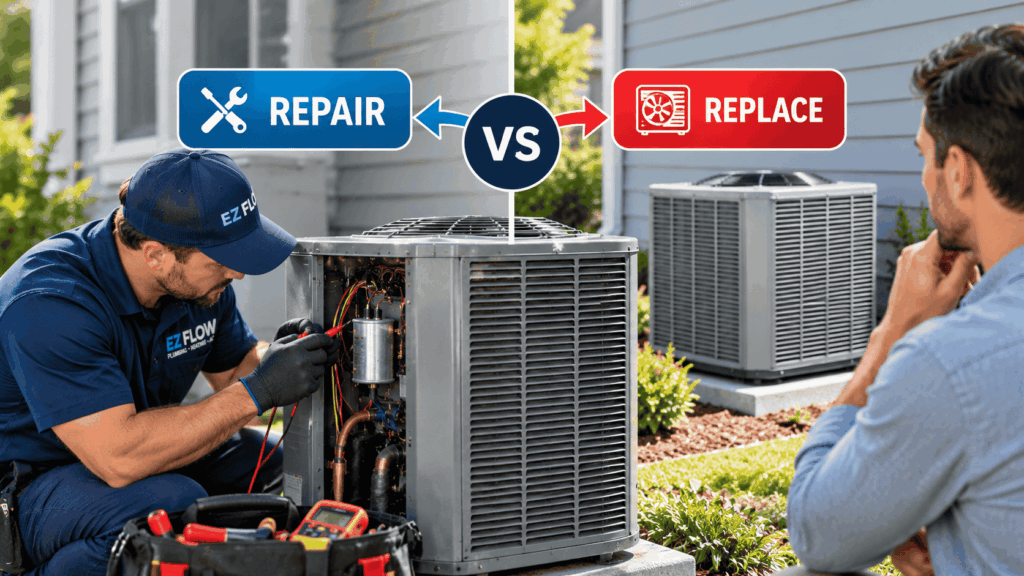
The choice between repairing and replacing an air conditioner should start with a diagnosis, not a formula. A repair often makes sense when the failure is isolated, the system has been reliable, the rest of the equipment is in reasonable condition, and the repair restores normal operation.
Replacement deserves stronger consideration when advanced age combines with a major repair, repeated breakdowns, poor overall condition, serviceability problems, or performance issues that the repair will not solve.
That means AC repair vs replacement is rarely decided by age or repair cost alone.
Start With The Diagnosis, Not The Age Or The Formula
Before asking whether an AC is too old to repair, find out what actually failed. A failed capacitor, thermostat, control, motor, condensate component, refrigerant leak, evaporator coil, and compressor are not equivalent decisions.
Even within the same component category, cost and significance vary with the system design, accessibility, warranty status, refrigerant, parts availability, and condition of the rest of the equipment.
If you are asking should I repair or replace my AC, the first useful question is:
What failed, and what will this repair actually restore?
An AC inspection should be able to explain the diagnosis before a homeowner compares repair and replacement quotes.
AC Repair vs Replacement: The Factors That Actually Matter
A useful decision looks at several factors together.
| Factor | When It Points Toward Repair | When It Increases Replacement Consideration |
|---|---|---|
| System age | System is younger or mid-life; years of reasonable service remain | System approaching or past 15–20 year typical lifespan; repairs compete with equipment reaching end of useful service |
| What failed | Isolated small component; does not indicate broader system failure | Major component (compressor, coil) combined with other factors below |
| Warranty | Failed component covered by active manufacturer parts warranty — dramatically reduces out-of-pocket cost | All warranties expired; full repair cost falls on homeowner; significant repair on aging equipment |
| Repair history | Isolated first significant failure; system otherwise reliable | Repeated failures across multiple components; escalating costs; same failure recurring |
| System condition | Rest of system is in reasonable shape; repair restores a healthy system | Multiple components aging or deteriorating; repair addresses one problem in a system with several others developing |
| Refrigerant | R-410A or current refrigerant; service is practical and economical | R-22 with significant leak; reclaimed R-22 cost ($150–$250/lb) can change the repair economics substantially |
| Cooling performance before failure | System was cooling well; repair restores proven performance | Persistent unresolved comfort problems — but only after ruling out ductwork, sizing, and airflow as the actual cause |
| Parts / serviceability | Parts available; service is straightforward | Parts difficult to source; refrigerant compatibility concerns |
No single row determines the outcome. A 16-year-old system that needs one modest repair can be a different decision from a 9-year-old system with a failed major component, recurring leaks, and several other deteriorated parts.
How Much Should AC Age Influence the Decision?
Age matters, but it is context rather than a diagnosis.
ENERGY STAR says homeowners should consider replacement when an air conditioner or heat pump is more than 10 years old. DOE uses an 18-year average life assumption for residential central air conditioning in life-cycle cost analysis. Neither statement means a specific system automatically requires replacement at 10, 15, or 18 years.
For is it worth repairing an old AC, age becomes more useful when paired with the current repair, repair history, warranty, refrigerant, and overall equipment condition.
A separate AC lifespan article should own the deeper age discussion. On this page, the point is simple: older age increases scrutiny, but does not decide the repair.
How Serious Is the Repair?
Repair severity matters because not every failure puts the same amount of money into the same amount of remaining equipment.
An isolated electrical or control repair may restore an otherwise healthy system. A compressor, evaporator coil, condenser coil, or major refrigerant-circuit repair usually deserves a broader comparison because the repair can be more involved and the condition of the remaining equipment becomes more important.
That still does not mean compressor or coil failure automatically equals replacement.
A major component failure on a newer system with warranty coverage can produce a very different financial decision from the same failure on an older system with expired coverage and a history of repairs.
Has the AC Been Breaking Down Repeatedly?
Repair history matters more when you look at severity and timing, not just the number of service calls.
One capacitor replacement and one condensate issue over several years do not carry the same meaning as repeated refrigerant leaks, multiple major electrical failures, or several expensive repairs within a short period.
Avoid universal rules such as “three repairs means replace.” Instead ask:
- Are failures becoming more frequent?
- Are they becoming more expensive?
- Is the same problem returning?
- Are different major components starting to fail?
- Has the system returned to reliable operation after previous repairs?
That pattern is more useful than repair count by itself.
Is the Repair Covered by Warranty?
Warranty can change the economics of a major repair quickly.
Before approving a compressor, coil, motor, or other significant repair, check the actual manufacturer warranty and any separate labor warranty. Do not assume every system has the same term or that a parts warranty also pays labor.
The relevant questions are:
- Is the failed component covered?
- Is the coverage still active for this owner and installation?
- What costs remain after warranty coverage?
A major repair that would be difficult to justify at full cost may look very different when the expensive component is covered.
What Condition Is the Rest of the System In?
A repair should not be evaluated only by the part that failed.
The stronger question is:
If this component is repaired, is the rest of the system reasonably healthy?
Depending on the equipment and diagnosis, an HVAC technician may need to consider coil condition, motors, electrical components, the refrigerant circuit, drainage, airflow, the air handler, the outdoor unit, controls, corrosion, and the system’s maintenance condition.
A repair is easier to justify when it restores an otherwise reliable system. A major repair becomes harder to justify when several other parts are already deteriorating.
Should You Use the $5,000 Rule or 50% Rule?
You can use these as rough comparison tools, but neither should make the decision for you.
The $5,000 rule multiplies the system’s age by the repair estimate. If the result exceeds 5,000, many contractor and manufacturer pages say replacement deserves consideration. Lennox currently publishes this formula.
The 50% rule says that when a repair approaches or exceeds half the price of replacement, replacement deserves stronger consideration.
I did not find either formula established as a mandatory engineering standard in the DOE, ENERGY STAR, ACCA, or AHRI materials reviewed for this article.
Both formulas miss important facts:
- what actually failed
- whether the repair is covered by warranty
- condition of the remaining equipment
- recent repair history
- refrigerant and serviceability
- parts availability
- actual replacement scope and cost
- homeowner plans
A 50% repair on a 4-year-old system and a 50% repair on a 17-year-old system should not automatically produce the same answer.
Does Refrigerant Type Change the Repair-vs-Replacement Decision?
It can affect serviceability and future planning, but refrigerant type does not automatically require replacement.
R-22 Systems
EPA ended U.S. production and import of new HCFC-22, commonly called R-22, in 2020. Existing R-22 equipment can still be serviced using reclaimed, recycled, or previously produced refrigerant.
An R-22 system therefore does not need replacement simply because it uses R-22.
However, advanced age plus a major leak, repeated refrigerant problems, expensive repairs, or poor overall condition can make replacement more practical.
R-410A Systems
Existing R-410A equipment can also continue operating and being serviced.
EPA’s current Technology Transitions rules affect new equipment differently from existing equipment. Components using R-410A can continue to be manufactured or imported for servicing legacy systems, with required service-only labeling.
EPA also changed the residential and light-commercial transition rules in May 2026, allowing qualifying pre-2025 higher-GWP inventory to continue to be installed until that inventory is exhausted.
Do not replace a serviceable R-410A system solely because newer equipment uses lower-GWP refrigerants.
Are High Energy Bills or Comfort Problems Enough Reason to Replace an AC?
Not by themselves.
A higher electric bill can result from utility-rate changes, hotter weather, thermostat settings, occupancy, longer runtime, duct leakage, other electrical loads, or equipment performance. Compare electricity consumption, such as kWh, when possible rather than using the dollar amount alone.
Uneven temperatures, weak airflow, long runtime, short cycling, or humidity problems can also involve:
- duct leakage
- blocked or restricted airflow
- thermostat problems
- dirty filters or coils
- insulation and air leakage
- incorrect equipment sizing
- installation problems
If your AC is running but not blowing cold air, diagnose the underlying cooling problem before assuming the system needs replacement. Replacing the AC will not automatically fix a problem that originates in the ductwork, airflow system, controls, or building envelope.
If replacement is being considered, it is also an opportunity to verify sizing rather than automatically installing the same tonnage again. ACCA identifies Manual J as the recognized residential load-calculation method, and AHRI emphasizes that split-system indoor and outdoor components should be properly matched for certified performance.
When Repair Can Be a Reasonable Choice
Repair often deserves consideration when several of these conditions apply:
- the problem is isolated and properly diagnosed
- the system has otherwise been reliable
- the rest of the equipment is in reasonable condition
- the repair is proportionate to the system’s expected usefulness
- an important failed component is still under warranty
- parts remain available
- cooling and comfort were good before the failure
- there is no pattern of major recurring problems
Even an older AC can sometimes justify a modest repair.
When Replacement Deserves Serious Consideration
AC Replacement deserves a stronger comparison when several factors occur together:
- equipment is approaching or beyond its expected service-life range
- a major component has failed
- the repair is expensive
- significant warranty coverage has ended
- recent repairs are becoming frequent or serious
- several parts show deterioration
- refrigerant or compatible parts make service increasingly difficult
- cooling or comfort problems continue after other causes are investigated
The key is the combination, not one checkbox.
Can You Repair Now and Plan Replacement Later?
Sometimes, a safe repair can function as a short-term bridge when the problem is relatively contained and the system can be returned to reliable operation. That may give a homeowner time to compare replacement quotes, budget for the project, wait for planned renovations, or schedule replacement at a less pressured time.
A bridge repair does not make sense if a qualified technician considers the equipment unsafe or if the proposed work will not restore reliable operation.
How EZ Flow Approaches AC Repair vs Replacement
EZ Flow Plumbing, Heating & Air Conditioning provides AC repair, maintenance, installation/replacement, and 24/7 emergency AC service across Bergen, Passaic, Morris, and Essex counties. Current EZ Flow service pages describe checking refrigerant, airflow, thermostats, coils, electrical/startup components, and controls when diagnosing cooling problems.
If replacement is appropriate, EZ Flow’s current installation page states that system selection is based on the property rather than square footage alone and that a written quote is provided after an in-home evaluation.
For AC service or an inspection, call (973) 337-1200 or request service through EZ Flow’s website.
Repair or Replace Your AC: The Bottom Line
Repair often makes sense when a diagnosed problem is isolated and the rest of the system remains reliable. Replacement deserves stronger consideration when age combines with a major repair, repeated failures, poor overall condition, serviceability problems, or verified performance issues.
Get the diagnosis first. Then compare what the repair will restore with the condition and likely usefulness of the system that remains.
Frequently Asked Questions
Should I get a second opinion before replacing my AC?
Yes, especially when the recommendation involves an expensive repair or full system replacement. A second diagnosis can confirm what failed, whether the repair is technically viable, and whether replacement is actually necessary.
Can a newer air conditioner still be better to replace than repair?
Yes. Age is only one factor. A newer AC may deserve replacement consideration if it has a major failure, recurring refrigerant leaks, multiple deteriorating components, serious serviceability problems, or a history of repeated expensive repairs.
Do I have to replace both the indoor and outdoor AC units together?
Not always, but split-system components must be properly matched. Replacing only one component can affect efficiency, performance, refrigerant compatibility, and certification, so the complete system should be evaluated before deciding.
Does an AC parts warranty cover the cost of the entire repair?
Not necessarily. A manufacturer parts warranty may cover the failed component while leaving labor, refrigerant, diagnostic fees, or other costs to the homeowner. Verify exactly what the warranty covers before comparing repair and replacement costs.
Should I replace my AC with the same size system I have now?
Not automatically. If replacement is chosen, the new system should be sized for the home’s actual heating and cooling load. A proper load calculation can identify whether the existing system was oversized or undersized instead of simply installing the same tonnage again.