
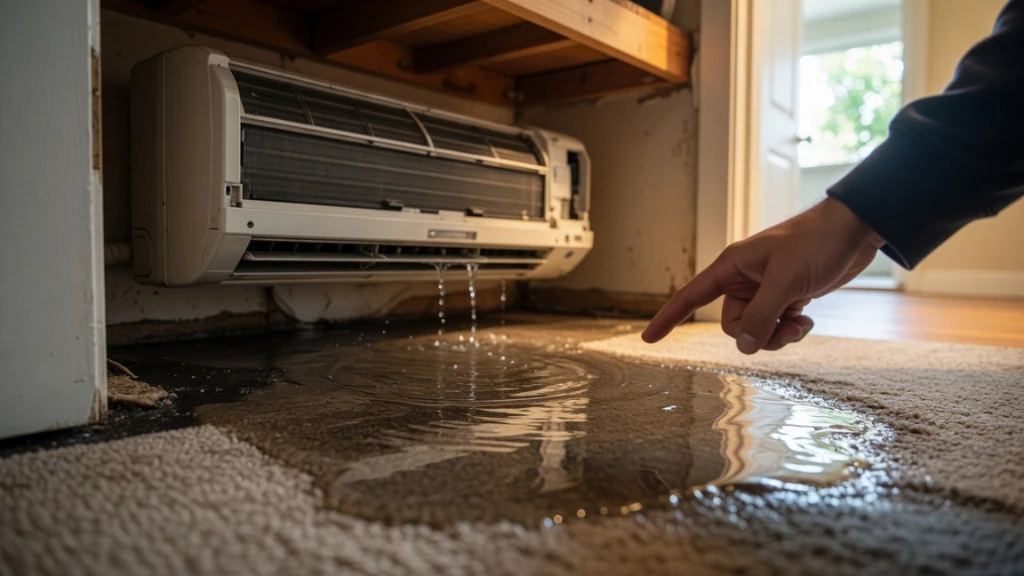
You walk past your air handler and notice a puddle where there shouldn’t be one. It’s a strange moment, air conditioners are supposed to make things cooler and drier, not wetter. But water leaking from an air conditioner is one of the most common calls HVAC techs get once the weather warms up, and in most cases it’s fixable without a full system replacement.
Here’s what actually causes an AC leaking water, what you can try on your own, and when it’s smarter to just pick up the phone.
Why Is My Air Conditioner Leaking Water in the First Place?
Every air conditioner produces condensation while it runs. Warm, humid air passes over a cold evaporator coil, moisture condenses out of it (the same way a cold glass sweats on a summer day), and that water is supposed to drip into a pan and drain safely outside through a small pipe.
When you see water leaking from an aircon, one of four things has usually gone wrong with that process:
- A clogged condensate drain line. Algae, dust, and debris build up inside the drain pipe over time and block the flow, so water backs up and spills over instead of draining outside.
- A dirty air filter. Restricted airflow across the coil causes it to get too cold and freeze. When that ice melts, it often melts faster than the drain pan can handle.
- A damaged or misaligned drain pan. Older metal pans rust through, plastic ones crack, and pans that were never leveled properly during install can overflow even when nothing else is wrong.
- Low refrigerant. A refrigerant leak drops the pressure in the system, which can cause the coil to ice over and then drip once it thaws.
Any one of these can turn into an air conditioner leaking water problem on its own, and it’s not unusual to find two happening at the same time, like a dirty filter that led to a frozen coil that then overwhelmed an already-slow drain line.
Central AC Leaking Water: What to Check First
If it’s your central air conditioning system, the leak is almost always near the indoor air handler, which is often tucked in a closet, attic, or basement.
Start with the easy stuff:
- Turn the system off. Running it while it’s leaking can make the mess worse and, if it’s a frozen coil, can strain the compressor.
- Check the air filter. If you can’t remember the last time you changed it, that’s probably your answer.
- Look at the drain pan for cracks, rust, or standing water that isn’t draining.
- Find the condensate drain line, usually a white PVC pipe near the outdoor line set, and see if it’s dripping normally or not at all.
A drain line that isn’t dripping at all during a hot, humid day is a strong sign it’s clogged somewhere in the run.
Window AC and Ductless Aircon Leaking Water
Water leaking from a window air conditioner is often simpler to diagnose because there’s less system to check. The most common cause is installation angle. The unit needs to tilt slightly toward the outside so gravity carries water out and away from your window, not back into your room.
Ductless mini-split systems (sometimes just called wall-mounted units) leak water for similar reasons as central systems, a blocked drain line, a dirty filter restricting airflow, or a frozen coil. Because the indoor head is mounted on a wall, leaks here tend to show up as water stains or drips down the wall itself rather than a puddle on the floor.
DIY Fixes for an AC Unit Leaking Water
If the cause is a clogged line or a dirty filter, this is genuinely something a lot of homeowners can handle themselves in under an hour.
What you’ll need: a wet/dry shop vacuum, a small bottle brush, white vinegar or a mild bleach solution, and a new air filter.
Steps:
- Turn off power to the unit at the thermostat and, if you’re comfortable doing so, at the breaker.
- Locate the condensate drain line outside your home, it’s the PVC pipe near your outdoor unit’s refrigerant lines.
- Attach a wet/dry vacuum to the end of the line (a piece of tape or a fitted attachment helps seal it) and run it for a minute or two to pull out clogs.
- Pour a cup of white vinegar down the indoor access point of the line every few months to keep algae from building back up.
- Replace the air filter if it’s visibly dirty or hasn’t been swapped in the last 90 days.
- Restart the system and watch the drain line for a slow, steady drip, that’s normal.
One honest limitation here: this fixes maybe 70% of water leak in AC situations, the clog-and-dirty-filter cases. It does nothing for a cracked drain pan, a failing condensate pump, or low refrigerant, and if you try to top off refrigerant yourself, you’ll run into a legal wall. Handling refrigerant without EPA Section 608 certification is against federal law, so that part is a professional-only job no matter how handy you are.
When Aircon Leaking Water Means It’s Time to Call Someone
Some signs point to a bigger repair than a weekend DIY project can fix:
|
Symptom |
Likely cause |
DIY or call a pro? |
|
Slow drip from drain line, filter is clean |
Minor buildup in line |
DIY (vacuum + vinegar) |
|
No water at drain line at all |
Deeper clog or frozen coil |
Call a pro if vacuuming doesn’t clear it |
|
Water pooling under the indoor unit |
Cracked or rusted drain pan |
Call a pro |
| Ice visible on the coil or lines |
Frozen evaporator coil, often low refrigerant |
Call a pro |
|
Hissing sound plus reduced cooling |
Refrigerant leak |
Call a pro (requires certification) |
|
Leak returns within weeks of a DIY fix |
Recurring drain slope or pan issue |
Call a pro |
Cost is a fair thing to want to know up front. According to Forbes Home’s AC leak repair cost guide, repairing a water-related AC leak typically runs between $125 and $325, while a refrigerant leak repair costs considerably more, often $250 to $1,550, since refrigerant work involves recovery, testing, and recharging under EPA rules. A basic drain line cleaning from a licensed tech usually lands on the lower end of that range.
Preventing Water Leaks From Coming Back
A little maintenance goes a long way toward keeping your system dry:
- Change your air filter every 1 to 3 months depending on your household (more often with pets).
- Flush the condensate line with vinegar two or three times a cooling season.
- Keep at least two feet of clearance around your outdoor unit so airflow isn’t restricted.
- Book an annual tune-up before the first real heat wave hits. A tech can catch a hairline crack in a drain pan long before it becomes a soaked ceiling.
We put together a longer list of seasonal HVAC maintenance tips if you want the fuller checklist, most of it applies no matter where you live.
A Quick Field Example
One thing techs see constantly: a homeowner calls about a leak, and by the time we get there, they’ve already mopped it up and the unit looks fine. Nine times out of ten, the giveaway is still there, a faint musty smell coming from the vents. That smell is usually standing water and mildew sitting in a drain pan or line that never fully cleared. If your AC has been leaking and now smells a little off when it kicks on, that’s worth mentioning to whoever comes out to look at it.
Conclusion
An AC unit leaking water is annoying, but it’s rarely a sign your system is dying. Most cases trace back to a clogged drain line or a dirty filter, both of which are fixable in an afternoon. The exceptions, cracked pans, frozen coils, and refrigerant leaks, need a licensed technician, partly for your system’s sake and partly because refrigerant work is federally regulated. If a leak keeps coming back after you’ve cleared the line and swapped the filter, that’s your cue to stop troubleshooting and get a professional opinion before water damage turns into a bigger repair bill.
If You’re in New Jersey
Everything above applies whether you’re dealing with a leaking window unit in Arizona or a central system in the Northeast, but if you’re local to North Jersey and would rather not spend your Saturday under a wet air handler, EZ Flow’s AC repair team covers Bergen, Essex, Morris, and Passaic counties with 24/7 emergency service. If the leak has already caused water damage to flooring or drywall, our water damage team handles that side too, so you’re not juggling two separate contractors.